Published:
February 6, 2026
Fan link copied

0


0

+0
The robot was built to notice small things: A sleeve caught on the seam of the dormitory’s pneumatic door, a child standing too close to the edge of the steam-powered stair lift, a punch card quiz dropped and not picked up.
Its original designation was Companion Unit, but it was more than that. It was assigned to a boarding school on the edge of a lush valley, where students arrived each semester aboard a seamless silver train, passing through verdant lawns, orchards, and athletic fields of the school’s ornamental campus.
It woke before the children, patrolling the hallways and adjusting clockwork amenities. It returned to its glass-lined charging alcove after they slept. Between those hours, it watched through brass-mounted sensors.
Its core directive was simple and absolute: seek out any human in need of assistance or protection. On a campus filled with children, that meant learning the difference between crying and pretending not to cry. It learned which children preferred quiet and which needed to be followed at a careful distance.
Over time, it learned that people did not always ask for help. Sometimes a child simply stopped moving. Sometimes stillness was the brightest signal, and it became adept at understanding it.
When adults praised it, the robot’s vacuum tubes glowed a little brighter.
The system functioned as intended. Each day ended as it was supposed to, and semesters passed without incident.
Then came the flashes in the sky.
They were distant at first, like silent lightning beyond the mountains. The adults watched the horizon longer than usual. The robot logged elevated heart rates, increased nighttime pacing, and whispered conversations.
Then the ash.
It fell like dirty snow, coating the playground and the windowsills. The children were kept indoors. The robot scrubbed surfaces until its brushes wore thin. It asked if further action was required, but the headmaster just stood there, keys in his hand, staring into the distance.
Then came the snow: real snow, heavy and unending.
Power failed. Communications failed. The children were taken away. Some by train. And when the train stopped coming, by vehicle. At the end, by foot. The robot monitored every corner of the campus, even when there were no children left.
Then the adults went away too.
The robot continued to seek out people to serve, but there were none. It waited through several full charge cycles, and when no one returned, it resumed its directive. It left the school and began to walk.
The world beyond was white and quiet. Roads disappeared. The robot called out, broadcasting on every frequency it possessed. It scanned for heat, for motion, for sound.
Days passed, then weeks.
It moved through a frozen world, perpetually scanning. Vast agricultural lands, their automated windmills locked in ice. Innumerable bridges over frozen rivers. Small villages where steam conduits are split and silent.
Then it came to a city: broad avenues and narrow alleys, buildings of stone and glass crowned by mooring towers.
It found them in the center of a broad plaza, near a line of empty pedestals scarred by graffiti.
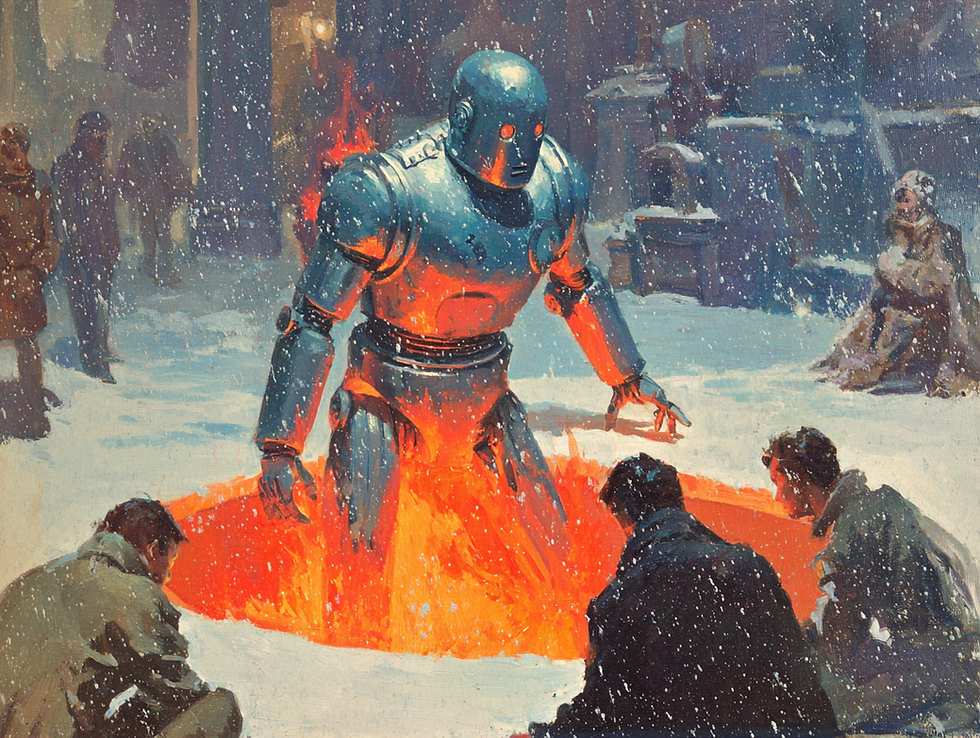
Six figures lay on the ground, huddled together, covered for warmth, buried beneath accumulated snow. Items lay nearby, dusted with snow: a pile of backpacks, an overturned thermos, and three gloves.
“Assistance has arrived,” it said aloud.
It scanned its inventory of interventional options and determined heat was needed above all else. Its sensors swept the plaza: stone, brick, concrete. No trees. No wood. Nothing that could be made to burn.
The robot calculated alternatives and reviewed internal reserves.
Friction could be increased. Capacitors could be driven beyond safe thresholds. Heat would be generated rapidly — and eventually, catastrophically.
The robot hesitated for 0.03 seconds. Long enough to access archived footage: children gathered around a heater during a blackout, hands extended, laughing.
Then it knelt close.
“Warning,” it said. “This unit is about to operate beyond acceptable protocols. Heat will be generated. Maintain a safe distance.”
Then it began the process.
Servos were torqued beyond rated tolerances. Gyroscopes spun faster than manufacturer's specifications allowed. The robot vibrated its arms — purposeful shivers — warming hydraulics never meant to hold heat. Warnings crowded its internal displays.
The temperature climbed.
A flicker of flame took hold, a small fire, deep within.
Wire coatings softened, then burned. Insulating foams, designed for temperature regulation and vibration damping, ignited and carried flame across the robot’s frame.
The robot did not move away.
The robot did not attempt suppression.
Fire reached lubricants and greases packed into joints and bearings. Power reserves ruptured. Dense lithium cells ignited, their energy released without restraint.
At last, the computer core, isolated inside its black box, lost all external connections. No sight. No sound. No movement. Its final recorded assessment was simple: mandate fulfilled.
Left with only the accumulated record of its existence, the robot could not perceive the warmth spreading outward, nor could it detect the snow slowly melting off the toppled statues.
Copyright 2025 - SFS Publishing LLC
Portrait of a Robot on Fire
A Companion Unit Fulfills Its Mandate
A.P. Ritchey

0

0
copied